What the finished product looks like
Every dossier uses the same 14-section system trusted in Fortune 500 pursuits — financials paired with management's own targets, an executive map with tenure flags, and your solutions tied to numbers your prospect has publicly committed to.
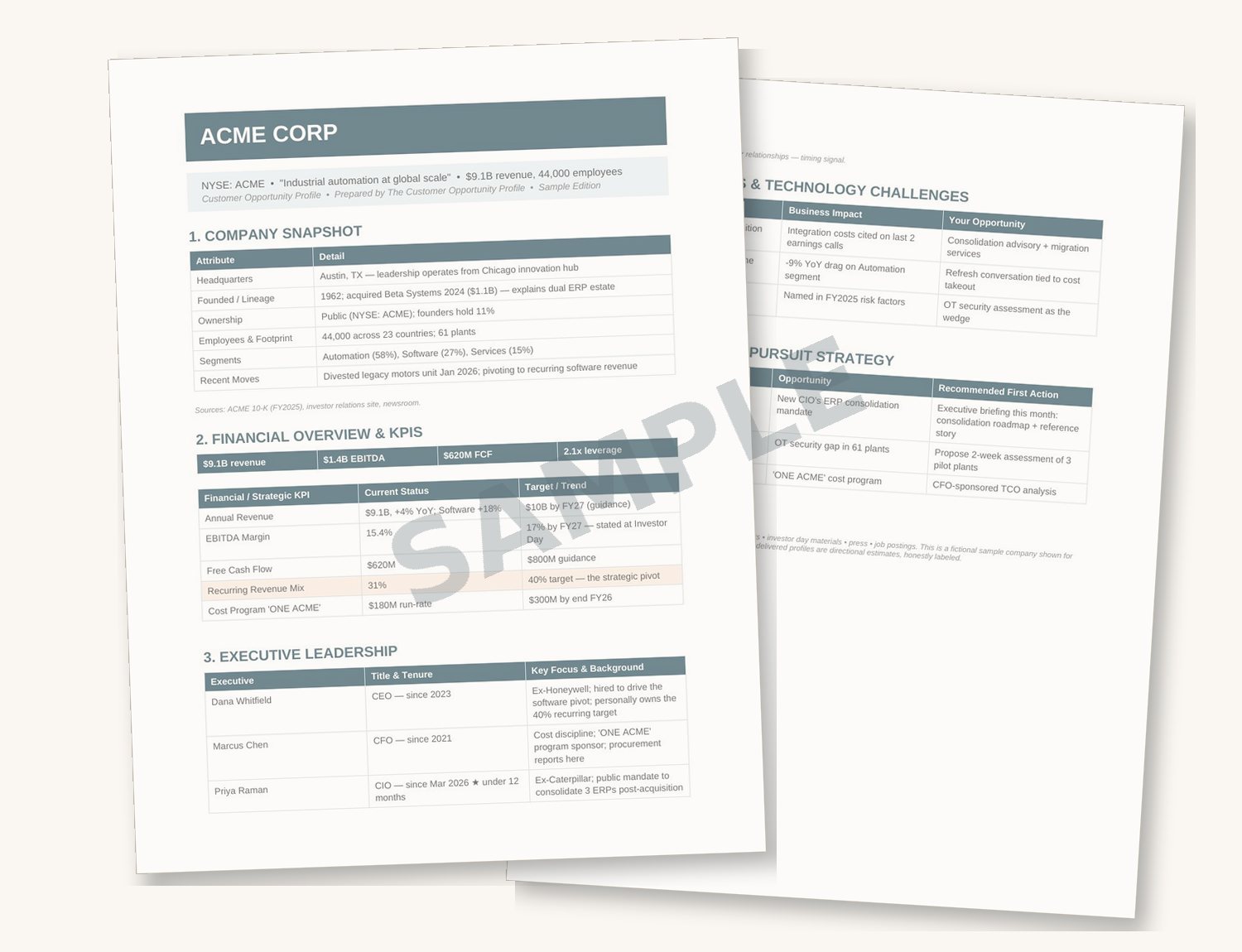
Watermarked sample on a fictional company. Your dossier is researched and built on your actual target after checkout.
How it works
No calls, no scoping documents, no waiting a week for a research agency.
Take the self-check
Seven questions about the deal — size, room, runway, competition. Sixty seconds. You get a straight verdict on the depth this pursuit calls for.
Tell us three things
Your company, what you sell, and the customer or prospect to research. That's the entire intake.
Open your inbox
Your dossier arrives the same business day — researched from primary sources, verified, and formatted to be forwarded straight to your VP.
Four depths. One system.
Every document researched, verified, and built for you. The difference is how deep it goes.
Account Targeting & Pre-Engagement Research
Know the company cold before the first call. 6 sections: snapshot, financials, executive map, operating KPIs, IT agenda, key challenges.
Start with the self-check →Initial Access & Multi-Threaded Engagement
Open doors — and open more than one. 9 sections, adding strategy pillars, your solutions mapped to their published KPIs, and a sequenced pursuit plan.
Start with the self-check →Deep Discovery
The complete 14-section boardroom dossier plus a first-meeting question set grounded in the research.
Start with the self-check →Custom Engagement
Consultative support for the deal you can't afford to lose: rigorous qualification, stakeholder mapping & orchestration, insight-led differentiation & messaging.
Book a scoping call →Not sure which depth you need? The self-check decides in sixty seconds.
Revenue is engagements × win rate × cycle speed.
The Opportunity Profile moves all three. One team package, pooled across every seller.
Research done before the pursuit starts
4–9 hours of verified account work per engagement, delivered the same business day — for less than the cost of one rep-hour. Reps open more pursuits without rationing the preparation each one gets.
Qualification before the pipeline
KPIs, budget signals, and executive priorities on paper before the first touch. Bad-fit accounts die in research — not in month four of the forecast. What enters pipeline has a documented reason to buy.
First meetings start further down the field
Reps arrive with the customer's KPI already confirmed on paper — so the first meeting starts at the value conversation, not the weeks of Q&A it usually takes to get there. Same-day research removes the dead week between trigger and touch.
Field-proven, and the math holds. Across a 30-year enterprise career and roughly $2B in closed revenue, the discipline inside every dossier — confirm the customer's KPI before the meeting, then sell straight to the value attached to it — repeatedly cut weeks of discovery Q&A and shortened real sales cycles.
The math: a $150K-OTE seller costs about $72/hour. The 6–9 hours of research a Deep Discovery replaces is roughly $575 of selling time, delivered for $49 — about an 11x return on every engagement, before a single incremental deal. The team figures above project that experience; the 90-day pilot measures it on your team.
Built by a seller, not a content farm
Efficient Work exists because generic research loses real deals.
The Customer Opportunity Profile started as an internal system: a working enterprise technology seller's method for walking into first executive meetings with more preparation than the incumbent. The 14-section structure, the verification discipline, the rule that every claim traces to a source — all of it was built for live seven-figure pursuits, then productized.
The bar for every dossier: it survives being forwarded to their CFO.
That's why estimates are labeled as estimates, executive titles are re-checked against current leadership pages, and anything that would be true of any company gets cut. Honest research reads as rigor — and rigor is what earns the meeting.
About the research: every document is researched from public sources with AI-assisted research and verified before delivery. Private companies disclose less than public ones, so some sections lean on clearly-labeled estimates. Executive names, titles, and figures can change — re-confirm anything customer-facing against current filings before you use it. These dossiers support your discovery and qualification; they never replace them.